
Interaction Media
Classify a medium at a named boundary. TCP names a transport protocol, AMQP names a messaging protocol, and Kafka can name either a broker system or its client protocol. Each can appear in the realization of one interaction channel. The tables describe what the participants can exchange, which state connects them, and how they access it.
Protocols and socket libraries
| Medium and boundary | Unit and exchange | Composition and scope |
|---|---|---|
| TCP connection | Each peer reads and writes an ordered stream of bytes in each direction. | An application supplies record framing. A read can return part of one write or bytes from several writes. |
| UDP socket | A sender addresses individual datagrams to a destination. | Datagram boundaries survive delivery. Loss, reordering, and duplication are possible. |
| HTTP client and server | A request selects a target and method. The response carries a status and may carry content. | HTTP/2 commonly uses TLS over TCP. HTTP/3 maps the exchange to QUIC streams over UDP. The operation contract determines what a successful status establishes. |
| AMQP 1.0 link | A sender transfers deliveries to a receiver on a directed link. Link credit controls transfer. Dispositions report delivery state. | Sessions multiplex links over a connection. A link may attach to a broker queue or stream. The attached node and its configuration determine retention and distribution. |
| ZeroMQ socket pairings | Socket patterns select the exchange, including REQ/REP for request/reply, PUB/SUB for publication, and PUSH/PULL for work distribution. | A messaging library supplies message boundaries and pattern-specific routing over transports such as TCP, interprocess communication, or in-process memory. Peers can connect directly. Durable replay requires additional machinery. |
Protocol and library references: TCP, UDP, HTTP semantics, HTTP/3, AMQP 1.0 transport, ZeroMQ socket patterns.
Broker and service boundaries
| Medium and mode | Participant-visible channel and state | Access exchange and progress |
|---|---|---|
| Apache Kafka topic | Producers append records to partitions. Consumers can independently reread retained records by partition offset. | Kafka clients issue Produce and Fetch requests over TCP. A group's committed offset records a restart position. Reading a record leaves it in the log. |
| Azure Event Hubs | A partitioned event stream exposes retained events to independent consumer groups. | Clients can send and receive through AMQP 1.0 or the Kafka endpoint. HTTPS also supports sending. Readers can resume from a checkpoint. |
| Amazon SQS | A work queue makes messages available to competing workers. Standard queues allow duplicates and best-effort ordering. FIFO queues scope ordering to a message group. | Send, receive, and delete are service API requests over HTTPS. Receive starts a visibility timeout. Delete uses a receipt handle. An undeleted message can become visible again. |
| Azure Queue Storage | A work queue holds messages for workers. A retrieved message can become visible again when its visibility timeout expires. | The REST API exposes put, get, and delete. Deletion identifies the message and presents its current pop receipt. |
| Core NATS | A subject routes live publications to matching subscriptions. A queue group selects one member per matching group. | Clients publish and subscribe through NATS connections. A request can include a reply subject. Subscribers that miss a live publication have no replay position. |
| NATS JetStream | A configured stream captures publications on selected subjects. Retention policy governs which messages remain available. | A consumer tracks delivery state and can expose push or pull delivery. Its acknowledgment policy and the stream's retention policy determine the effect of acknowledgment. |
Service references: Kafka protocol, Event Hubs partitions and consumer groups, Event Hubs access protocols, SQS visibility, Azure Queue Storage retrieval, Core NATS, JetStream.
One publication through Kafka
At the application boundary, a producer publishes a record and a consumer may observe it later. In the acknowledged Produce mode illustrated below, the record enters Kafka in a Produce request and leaves in a Fetch response. The consumer initiates the fetch. The retained partition connects the two exchanges across time, including when no consumer is connected at publication.
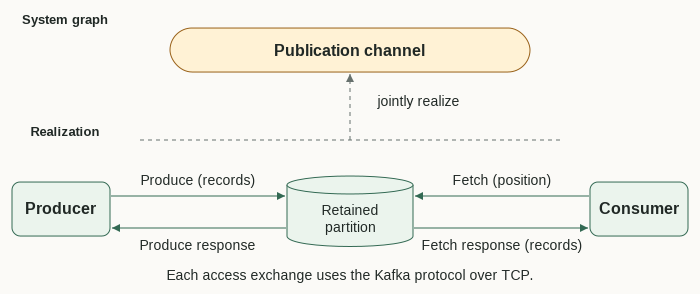
Each client uses the Kafka request/reply protocol over its own TCP connection in this example. One request can carry a batch. A successful Produce response reports acceptance under the selected acknowledgment setting. A producer using acks=0 receives no Produce response. A Fetch response can return the record repeatedly while it remains retained. Committing an offset is another operation with its own failure boundary. A claim that an application effect occurred requires evidence at the application's commit boundary.
The same composition method works in the opposite direction. A Core NATS requester subscribes to a reply subject and publishes a request carrying that subject. A responder publishes its answer there. Those two publication directions realize a request/reply exchange. The binding identifies the matching reply and the protocol determines when the requester may consider the interaction complete.
Formal relations
documents: Interaction Channels — Classifies public media by the exchanges, retained state, and access paths that can realize a logical channel.documents: Interaction Bindings — Shows how an outer publication maps to different roles in two constituent client exchanges.